Scheduling Folk
Keeping in touch with people is something I care about, but there’s plenty of folk that I care about that I wouldn’t stay in contact with the regularity that I want without proper scheduling. Unless it’s more than once a week, the habit just doesn’t form, and life gets in the way.
A few years ago, I started treating it like a systems problem and built a scheduling layer around it. Motivated by a recent chat with some interested parties, this post briefly documents that system, how it broke, and where I’ve landed.
Some philosophy
I dinnae want to turn this post into a pontification on humans as social creatures, and compare and contrast (possibly outmoded) models of evolutionary psychology vs contemporary and future-facing aesthetics of the woven nets of relationships that we want to build. Buy me a coffee and yap on that one-on-one.
However, keeping up with folk is something I like to do, and I believe in the power of my own agency: that I can decide the things I want to do, and have some understanding of why I want to do it.
Once I’ve exercised the agency of choice, I’m keen to minimise the number of low-agency steps required to achieve that. This is why I like having keyboard shortcuts for common tasks: intent, action, and result should all be closely linked.
Given that, exercising the agency of “I want to maintain this relationship with someone that I’m not constantly thinking about” (e.g., not a partner or immediate family member) can be thought of as a systems problem, intersecting with the social dynamics of it all. Understanding what stage a relationship is at, if you or the other person just isn’t feeling it and you should back off, and what you should be talking about is all something I want to be using my own judgement for.
Or put simply, I want to be the one actually living my relationships, any tooling around it should just make that easier.
We can automate the other parts, but that seems a bit grim. Born, push a button to do all the things in your life, die.
In typical tech person fashion, let’s quickly make the evil thing, because it can be done. I beg you not to use the following script:
import anthropic
from people import Person, is_due


def build_prompt(person: Person) -> str:
    history_block = "\n".join(f"- {m}" for m in person.message_history[-3:]) or "None"
    return f"""
You are helping someone maintain their relationships. Draft a short, warm, natural message to send to:

Name: {person.name}
Relationship: {person.relationship}
Contact frequency goal: {person.frequency}
Last contacted: {person.last_contacted}
Recent message history:
{history_block}

Keep it brief (2–4 sentences). Don't be generic or sycophantic. Match the tone to the relationship.
Make it genuine, witty, and not weird.  The feeling of living in an alienated dystopia where even the
connections between friends has melted away to tokenisation should *not* come across.
""".strip()


def generate_message(client: anthropic.Anthropic, person: Person) -> str:
    response = client.messages.create(
        model="claude-opus-4-5",
        max_tokens=256,
        messages=[{"role": "user", "content": build_prompt(person)}],
    )
    return response.content[0].text.strip()


def run(people: list[Person]) -> None:
    client = anthropic.Anthropic()

    for person in people:
        if not is_due(person):
            print(f"⏭ Skipping {person.name} — not due yet\n")
            continue

        print(f"✉ Generating message for {person.name} ({person.relationship})")
        msg = generate_message(client, person)
        print(f" → {msg}\n")
The original system: Emacs org-mode
My first serious attempt was back in late undergrad, and used org-mode in Emacs.
Emacs is a family of text editors that traces its roots back to the 1970s, originally developed at MIT. The GNU Emacs branch, maintained by Richard Stallman — of the Free Software Foundation and GNU Project fame — has been the dominant strain since the 1980s and remains actively developed today. It’s less a text editor than a Lisp runtime that happens to be very good at editing text.
.jpg) Stallman at FOSDEM 2005. Photo by chrys,
CC BY 2.0.
Stallman at FOSDEM 2005. Photo by chrys,
CC BY 2.0.
Org-mode has a built-in scheduling syntax that lets you attach dates and recurrence patterns to any heading. The agenda view then collects everything due today across all your files — a kind of personal dashboard.
A contact entry might look like this:
* Vangelis Ogunkunle
  SCHEDULED: <2026-01-15 Thu +4w>
  :PROPERTIES:
  :CATEGORY: folk
  :END:
The +4w suffix is a repeat interval: once you mark the task done, it
reschedules itself four weeks forward. You can also use ++ (shift by interval
from today, not from the original date) or .+ (shift from today, but only
forward) depending on how strict you want to be about drift:
SCHEDULED: <2026-01-15 Thu ++4w>   ; always lands on a fixed cadence
SCHEDULED: <2026-01-15 Thu .+4w>   ; 4 weeks from whenever you actually did it, my preferred approach for this
Running my shortcut for M-x org-agenda and pressing a gave me a daily/weekly
view of everyone I was due to speak to. It was great. The system lived in a
single folk.org file, was version-controlled with the rest of my config, and
required zero internet access.
I would take a look at my agenda, see who I felt like messaging that day, and adjust the schedule frequency if I felt it needed to be made more or less frequent.
A typical day might look something like:
Sunday     12 April 2024
================================================================================
 Folk
  folk:                      Lorna Rauf
  folk:                      Aunt Redacted
  folk:                      Akshil Wierzbicki

 General Tasks
  agenda:                    Watch Welder talk
  agenda:                    libclang exploration
  agenda:                    ALIFE conference review
Crucially, I’m not obliged to message a person on that day, they will roll over until I actually check them off.
The agenda view is just one piece of it — org-mode and Emacs more broadly are very configurable through their built-in customisation system and init file. Want custom agenda commands that filter by tag, show only people you haven’t contacted in over a month, or group by city? All doable. The price of admission is a willingness to spend time in the parenthesis mines of Lisp.
How it fell apart
I moved to London in 2024, and suddenly found myself with a tube commute, and a corpo laptop. I didn’t feel comfortable putting my social web on something that could ostensibly come out in discovery or the whims of company IT.
I also found I wasn’t using my personal laptop daily, I was out and about doing stuff in my off-hours. As a result, I found a few months in “hey, I’ve not been maintaining some of the relationships that I care about, why is that?”.
I realised that my system was reliant on daily use of my personal laptop, and the time that I was free to message and catch up with people was on an underground train, on mobile, with minimal internet connection.
Alas, Emacs as I use it is not well suited to the mobile experience, so I needed a stop-gap solution.
Google Calendar Tasks: a workable compromise
Google Tasks (built into Google Calendar, and also as a standalone app) turned out to be a reasonable middle ground. It syncs to my phone, works offline on the underground, and supports due dates with recurrence. I’ve given social tasks their own colour, to make them distinct from other tasks and calendar events.
The workflow is simple: each person gets a task, set to repeat on whatever cadence makes sense. When I’m on the tube, I can take a look at my Google calendar for the day, and see who’s up.
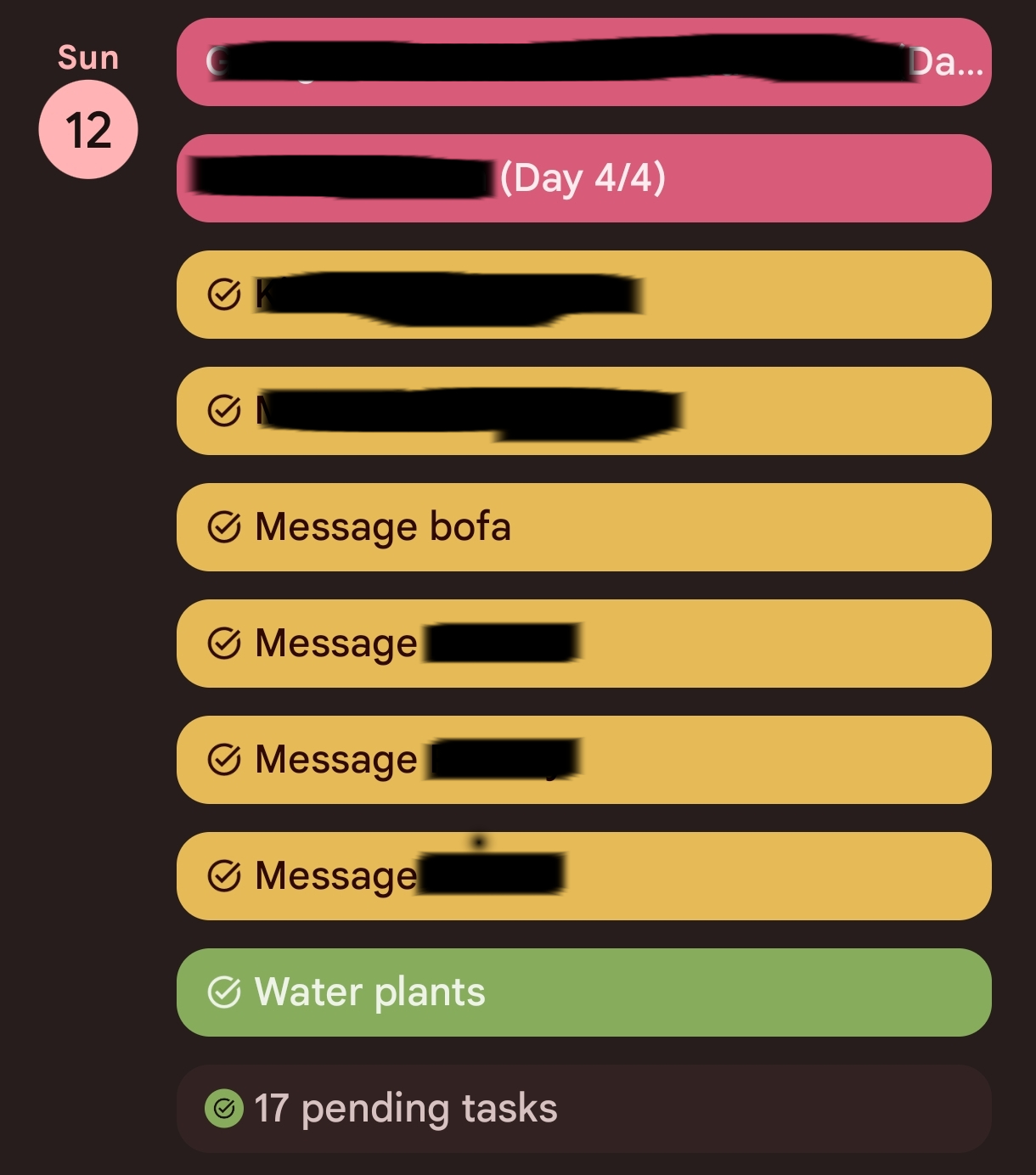 Day view — folk tasks show up in yellow alongside regular calendar events.
Adding a new contact task is just a tap on the + button, then selecting “Task”:
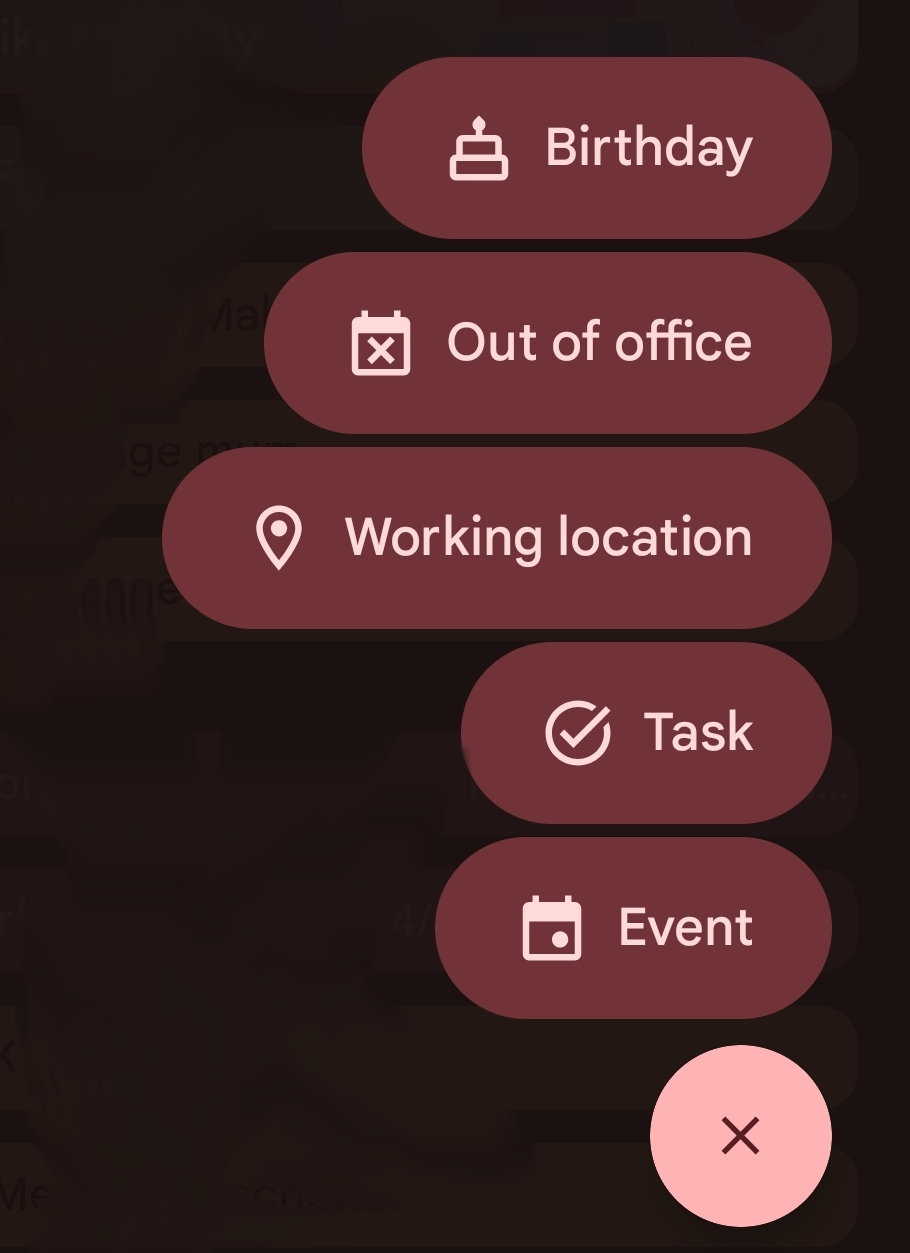 The new item menu — Task sits alongside Event and other options.
Each task gets a repeat interval, set at creation:
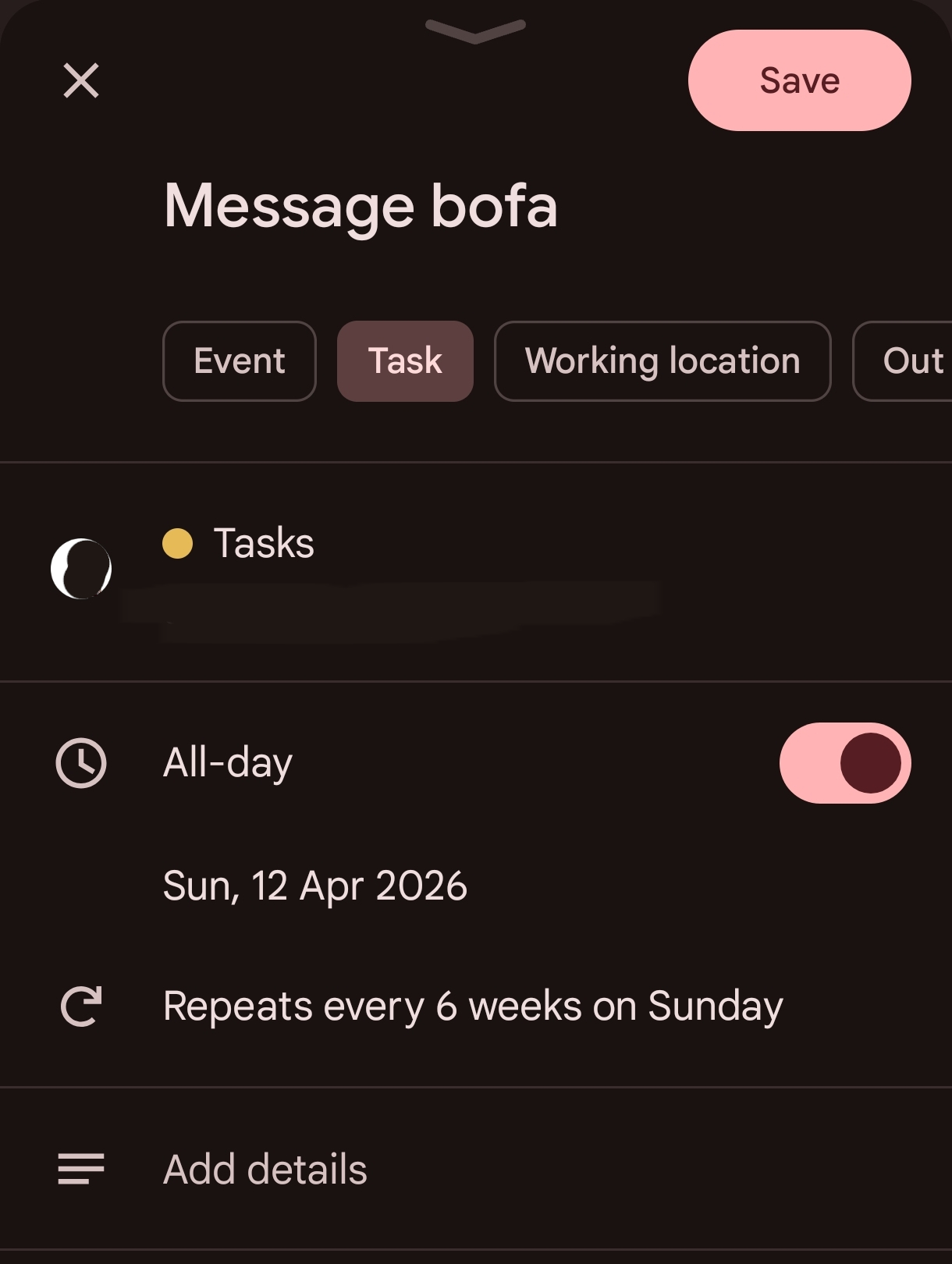 Setting a 6-week repeat on a contact task.
It doesn’t have org-mode’s expressive repeat syntax, and the wide scope of additional configuration I’d like to have. But it’s good enough, and critically, it’s always with me.
The future: getting back to org-mode
The org-mode approach is still the one I’d prefer. The plain-text format, the expressive scheduling syntax, increased privacy, the dork creds, and the composability with the rest of my Emacs workflow are hard to replicate. The question is just whether I can get it onto my phone reliably enough to replace Google Tasks for the commute use case.
In an era of agentic coding, sure it will be way easier, however the question is how arsed I can be, given this approach seems to be “good enough” for how my life is going right now.