It Wasn't Supposed to Work: From the AI Winter to AI Agents with Robert Hooker
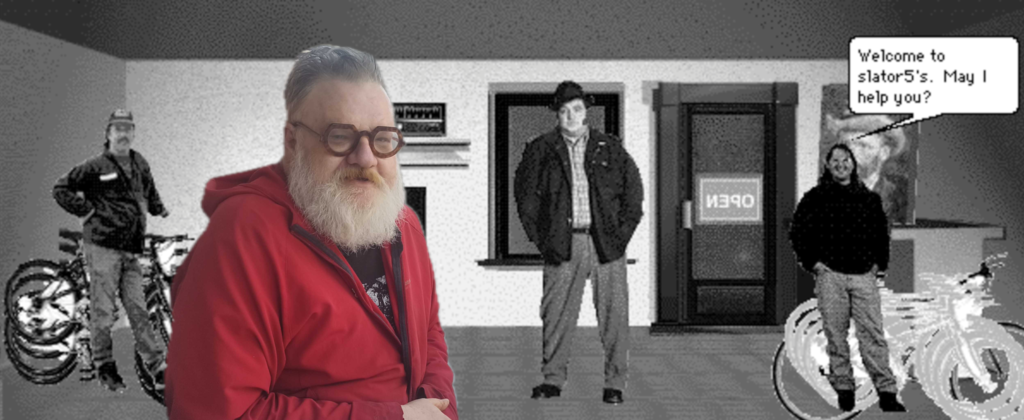
I was sitting in a coffee shop earlier today, when the waitress asked where I was from. A fella over at the next table caught the accent, and we got talking. Somewhere in the next few minutes he mentioned he’d worked in an AI lab during the AI winter of the late 80s, and I thought, since this random conversation seems to be happening anyway, let’s capture it. I asked if he’d be comfortable making it an interview format with transcription, so we agreed to sit down properly.
Robert Hooker has been working in IT since 1989, starting at Northwestern University’s Institute for the Learning Sciences and ending up in London, some thirty-odd years later, running the internal AI adoption programme at a social care charity. He says he’s watched this happen before.
So tell us a wee bit about yourself and how you got started.
My name is Robert Hooker. I’m a senior person in cloud computing. I have been working in the field of IT since late 1989. I first worked in the United States at Northwestern University’s Institute for the Learning Sciences. This was during the AI winter, so the Institute was actually an AI lab.
The researcher who ran it was Roger Schank, a famous early AI researcher, who I gather sadly features in the Epstein files. He was one of the people who introduced the concept of “scripts” in early AI. An interesting field, in a relatively failed branch of AI back then.
We were still in what I call the Minsky winter, when Marvin Minsky thought he had proven that neural nets would never work. So people weren’t working on them, and they were trying to teach computers how to think in Lisp and getting nowhere.
Just to check, the Minsky proof, that was the XOR problem?
Yeah, of course.

.jpg)
And so I was being trained that machine learning was just really stupid, but a lot of our people were very interested in it. It was a nightmare.
I do have a published academic paper, from a conference, Hooker and Slator, on a model of AI decision-making. It didn’t say AI, of course, because we were in the AI winter. But it was about how agents make decisions in an economic role, by the agents simulating pursuits.
And that was where I introduced Brian Slator, who went on to North Dakota State University to do the rest of his career research there.
But I didn’t stick around in academia. In the mid-90s I went to the private sector, going from web design, to SharePoint, to cloud, to Microsoft 365, and now Copilot. The guiding principle, which I’d recommend to all the young people in IT: if you can’t beat them, join them.


"For us older guys, this wasn't supposed to have worked. And it just blew our minds."
Have you come across the idea of Sutton’s Bitter Lesson? I work in the neural network space, and the idea addresses the frustrating trend that you throw more and more compute at the problem and it just somehow works better.
Oh yeah, that principle. Which wasn’t supposed to work. That’s what was amazing.
I gave an interview about 16 years ago on a podcast called The Future And You, and he asked me about predictions. And I did not say that. Some voice recognition, maybe, but the way I hedged it was: “I’ve been surprised before.”
When you work with a small neural net, there’s an optimal number of layers, there’s an optimal amount of training. But when you have a massive set of these weighted neurons, for us older guys, this wasn’t supposed to have worked. And it just blew our minds.
It took a while convincing. It took me several months of playing with OpenAI to be convinced that it actually was working. And here’s the thing. If you go to it determined to show it doesn’t work, it’s very easy. It’s very, very compliant in not working for you.
I suppose you get the answer you went looking for.
An interlude in Edinburgh
The reason we got talking in the first place was you’d mentioned being in Edinburgh for the 2014 referendum. What was that like, being in the buzz of it?
Oh, it was a lot of fun. My wife and I, my late wife, if I can make a plug for her, her name was Gail Orenstein. Just Google “female drone journalist”, she shows up. She died five years ago, which is unfortunate, but she was a very well-respected journalist. It was always a lot of fun with her.
I was working remote at the time, so I could go and spend a whole week in Edinburgh while working. And to be honest, this wasn’t like the Brexit referendum. It wasn’t ugly, it wasn’t bitter, at least in Edinburgh. There were some fisticuffs that we saw, and some crazy things being yelled back and forth, but for the most part I saw it as an amazing celebration of Scottish identity, tempered with Scottish practicality.

Ha, mind you, the fisticuffs might just have been a typical night out in Edinburgh.
Or even lighter than a typical night out in Edinburgh.
I also do art, and I found it artistically very inspiring. Edinburgh is just inspiring to begin with, but then to see all this going on as well. I was doing illustrations where I brought Edinburgh alive by merging the statues with the people. My drawings included the birds on their heads taking shifts, because that’s what you actually see.
And one of the great joys of being a journalist is that you’re an observer. The thing that really struck me, comparing it to the Brexit nightmare, was a wedding photograph where the bride was Yes and the father was No Thanks. It was a great photograph. Brexit was never like that. Brexit was just ugly.
Aye, definitely a more alienating experience, at least from how I saw it.
The dot-com bubble, and who held their nerve
You mentioned being around for the dot-com bubble. What was that like?
In the late 90s it was great. A lot of my friends were working as contractors in IT, and deployment was still pretty limited and very development-focused. Two things got the IT community involved.
One, it was the first time something was being delivered where you didn’t have to install anything on the end machines. The same bit of work could go on an Apple. People forget how revolutionary that is.
Secondly, it was the introduction of lightweight languages that weren’t C or C++. You could run websites on PHP, which was a bit poor, but it was very revolutionary at the time. Then ASP came out, and that took off too. Java Server Pages were too heavy-handed and didn’t take off. And then JavaScript, and you could separate what was happening on the client.
So suddenly there was an easy level of entry if you were a technical person. And suddenly there was demand for graphic art skills, which there hadn’t been before. All of our friends in the late 90s were suddenly making a lot of money. That’s when I moved to England with my wife, because she was a photojournalist and wanted to be in England for obvious reasons.
But the investment was way over the line. And when that dried up, for a few years you couldn’t get any work. It was really, really hard. The bomb hit in 2000, and by late 2002 it was as much because of 9/11 as it was because of the internet. The financial system just stopped funding. But within three years it was back up and running.
So what’s the lesson you’d draw for what could be called the contemporary AI bubble?
The people who didn’t panic and stuck with the internet during the dot-com bomb, when all the brains were saying it was bad, the Bezoses and the Zuckerbergs, they’re the richest people on the planet right now. So better to be closer to the people who held their nerve, if you have a choice. I’ve been there before.
There’s probably a good few AI Pets.com knocking about right now. But Amazon came out the other side looking not bad at all.
Maybe. But there is a difference. Back in the day you could create a website on a single server plugged into the internet. You could pay under $1,000 for the server, run e-commerce on it, deliver solutions on a pressed CD. It’s not like that now. You’ve got big players who are really well-heeled. Amazon, Microsoft, Google, and Meta all have revenue streams. Those are the big players in AI.
I famously missed the social media wave, by the way. I had a nephew who attended Harvard at that time, and he comes in and says “a friend of mine is creating a social network”, and I said, “Microsoft and Yahoo are dominant.”
Auch, geezo. That’s a story to tell at least.
What he’s doing now
So what is it you’re doing now?
Right now, my wife passed away five years ago, so I kind of slowed down. But I’m working for a not-for-profit called Dimensions, which just won an award for being the best workplace in social care and not-for-profit in the UK. We’re the UK’s biggest not-for-profit provider of support for adults with learning disabilities and autistic people, but we don’t even have 3% of the market. So even though we’re the biggest, and we grow like crazy, we’re not quite sure where to go in the future.
I was hired about four or five years ago to work with cloud computing and architecture. But then AI got introduced, and so what I’ve been doing for most of the last two years is overseeing our internal AI adoption project.
And how’s that going?
Very interesting, but also very challenging, especially with security teams. They want some kind of framework to make sure their AI is compliant. And I keep telling them: these frameworks don’t work as of yet.
I was at a conference by one of the vendors, and I kept asking, “look, I’m building these AI agents. I’ve been told by security that they’re concerned, without them telling me exactly why. So how do I structure my project?” And all they say is “buy this product.” No. That’s not going to fix it.
I know from being an architect, you have your business requirements statement, and a process that takes you from there to something you can test. That isn’t here in AI as of yet. The big problem with an agent business requirement is that people don’t know to ask for a chatbot that has cognitive skills in a certain area. So we get people to understand LLMs, then get them to understand what agents can do. And then suddenly the use cases come out of the roof.
What are the concerns, especially given you’re working with quite sensitive data?
First of all, I’m doing it very differently from a lot of the big businesses. I’ve talked to friends of mine who are concerned, in large part because the companies are coming in and deploying it as if it’s an old factory where you put in new machinery, kick the staff out and put security guards in front of it. That isn’t how we’re doing it, and I don’t think that’s going to work.
Because we’re a not-for-profit, almost everybody working with us could make more money somewhere else and they choose to stay anyway. So we have a motivation factor that isn’t just the money. That gives us an opportunity, because they actually trust us.
So we’re getting people who are overwhelmed, constantly having to file this report and that report, keeping the news updates going, updating the web page and the intranet page, underpaid and we can’t hire new people. And I’m saying: alright, here’s Copilot, this is what it can do, ask me about it. And then we get them to discover the uses.
So it’s grassroots? You’re trusting your colleagues’ expertise and seeing where you can cut, so they can focus on what actually matters?
Yeah. They’re focusing, and I’m out there to support them with the technology.
And the compliance side of that?
We’re constantly getting more and more regulations about how to work. We have to have a person whose only job is to tell us what’s GDPR compliant and what isn’t. So we have to spend money and effort on it, and keep going on it. It’s kind of a pain, but we do it.
Mind you, the punishment for not bothering is really just your reputation. If you’re determined to keep yours, you do it properly. So it ends up being a kind of self-imposed punishment for the people who decide to do it the right way.
And the thing is, you can also use GDPR to annoy people. You just go on an AI and it can write a GDPR request, and you can inundate somebody you’re mad at with them. Although I’ve spoken to the people who handle ours, and they don’t think they’re getting many of those. Ours are mostly sincere, very often because somebody’s moved house and they just want to make sure their record is complete.
So the future of agents is folk flooding their competitors with GDPR requests using agents, and then those agents responding to all of it.
They’ve been doing that with lawsuits forever.
Aye, lawsuits, patent trolling. It’s cheaper to annoy.
You don’t have to be a rich person to make somebody’s life miserable.
Why the code monkey is going away
"You have to become an expert in every agent you write."
Has building agents changed how you’d approach a project?
One of the things you learn very quickly with agents is that the old traditional “give me the requirements, I’ll write the use cases, and I’ll code it” does not work in cognitive computing. You have to become an expert in every agent you write. If it’s a finance agent, you have to become an expert in finance.
There was a project manager who wanted an agent, and at first I thought I’d just point it at all their templates and processes. And it was okay. But to get it to work appropriately, what I had to do was write proper ontologies into the RAG to explain how the work actually worked, and run it through, and run it through.
I end up having to learn, which I enjoy, but I think in the future a good programmer in AI isn’t going to be a code monkey. Code monkey is going to be a career that goes down. It’s going to be somebody who works in a certain field and is really good at cognitive descriptions of that field. Somebody who can understand what cognitive skills are necessary to do a particular job.
Which pushes AI more into psychology, sociology, and literature. I have an undergraduate degree in cognitive science, and that’s been much more useful than anything else in the current work. Particularly behavioural theory.
Go on, what carries over?
One rule of cognitive theory is that it’s not enough to say no. If you’re correcting a behaviour that’s wrong, it’s very hard to just tell someone to stop doing it. You have to tell them the proper behaviour instead.
So when you do a RAG design and your instructions are just “don’t do this, don’t do that”, it’s not going to be as effective as one that says “do this rather than that.” That’s solid psychology.
Computer programmers think if-then, if-then. And it didn’t matter if it was negative or not. Nobody worries about that. But human beings don’t work that way. What works for humans is “not this, rather this.”
Aye, rather than the strict logic of C, you’re almost shaping a surface for it to slide towards what you want.
I don’t know what’s going on in the industry side of it, but I do know from behavioural cognitive studies that this has been established for almost two centuries now as the right way to go.
That resonates. Two years ago 80% of my job was writing code; now maybe it’s 5%. A lot of it is managing agents, and another part is just talking to people.
Mine was the same. About five years ago 80% of my job was writing documents that nobody would read. Now I do none of that. Now I’m talking to people.
Hallucination, or imagination
"In probably 10 years they'll rename hallucination to 'imagination'. Because that's really what it is."
What about the risks?
The back-end ones we’ve covered. The big risk on the front end is, of course, hallucination. And you can lecture all you want, but people are going to have to learn from their own negative experience. Unfortunately, if you go on social media, people think that one negative experience proves the whole thing doesn’t work.
But this is one of the things I’ve learned. I’ve had some agents where I put in such guardrails that they wouldn’t hallucinate. The problem was that they couldn’t generate new thinking either.
Right, you make it so safe it can’t say anything useful.
I just thought hallucination was bad. But look, you’re a human being. I may ask you a question about something you’ve never dealt with before, and you may imagine some solution. You’re going to have to test it, but you might come up with something.
So you need to look at the domain. Is this something that needs a precise legal answer? Turn hallucination down. Other things, like drafting job adverts or public announcements, those things need to hallucinate some.
In probably 10 years they’ll rename hallucination to “imagination”. Because that’s really what it is. And people will just take it for granted: don’t let the thing’s imagination get away with it. You’ve got to contain its imagination. I think it’s a better term.
Any other experiences that have made a difference?
The biggest one is getting people to not write prompts, but to write prompts that write prompts. Write a prompt to write a prompt, then review that, then run the prompt. That’s the best way to go. The AI speaks AI better than you.
Cheers Robert, one of the more fruitful random coffee shop conversations I’ve had.
He had a sketchbook with him, and got me to photograph a couple of pages before I left. Not the Edinburgh statues he’d described (from over a decade ago), but pen studies of insects, flowers, shells, and shapes coming apart.


We chatted a bit more off the record after that, and then I finished my coffee and carried on with my day.